For most people, the word "budget" triggers feelings of restriction, sacrifice, and endless calculations inside complex spreadsheets. But personal finance does not have to be painful. A budget is not a set of handcuffs; it is a roadmap that gives you permission to spend money guilt-free on the things you truly care about.
Without a clear structure, it is easy to look at your bank account at the end of the month and wonder: *where did it all go?* This beginner-friendly guide breaks down the most effective, stress-free personal finance framework, explores the technical math behind robust savings, and explains how to handle shared group expenses cleanly.
Historical Context & The Evolution of Budgeting
To understand the power of modern budgeting, we must look at how our relationship with money has transformed over the decades. Historically, budgeting was a highly tactile, physical endeavor. In the early-to-mid 20th century, households relied heavily on the "Envelope Method"—literally placing physical cash into labeled paper envelopes for groceries, rent, and utilities. Once an envelope was empty, spending in that category ceased until the next payday. This tactile constraint kept consumer debt remarkably low but offered zero flexibility.
The technological shift began in the late 1980s and 1990s with the advent of personal computers and early spreadsheet software like Microsoft Excel. While spreadsheets digitized mathematical calculations, they required tedious manual entry that discouraged the average consumer. The real revolution arrived in the 21st century with mobile banking, automated transaction synchronization, and browser-first web applications.
In 2005, then-Harvard bankruptcy expert Senator Elizabeth Warren popularized the 50/30/20 rule in her book *All Your Worth: The Ultimate Lifetime Money Plan*. This shifted personal finance from granular, exhausting bookkeeping to a macro-allocation strategy. Today, rather than counting pennies, we allocate entire income streams dynamically using lightweight, browser-based calculators and split-expense tools, balancing modern speed with robust financial security.
The 50/30/20 Budgeting Framework
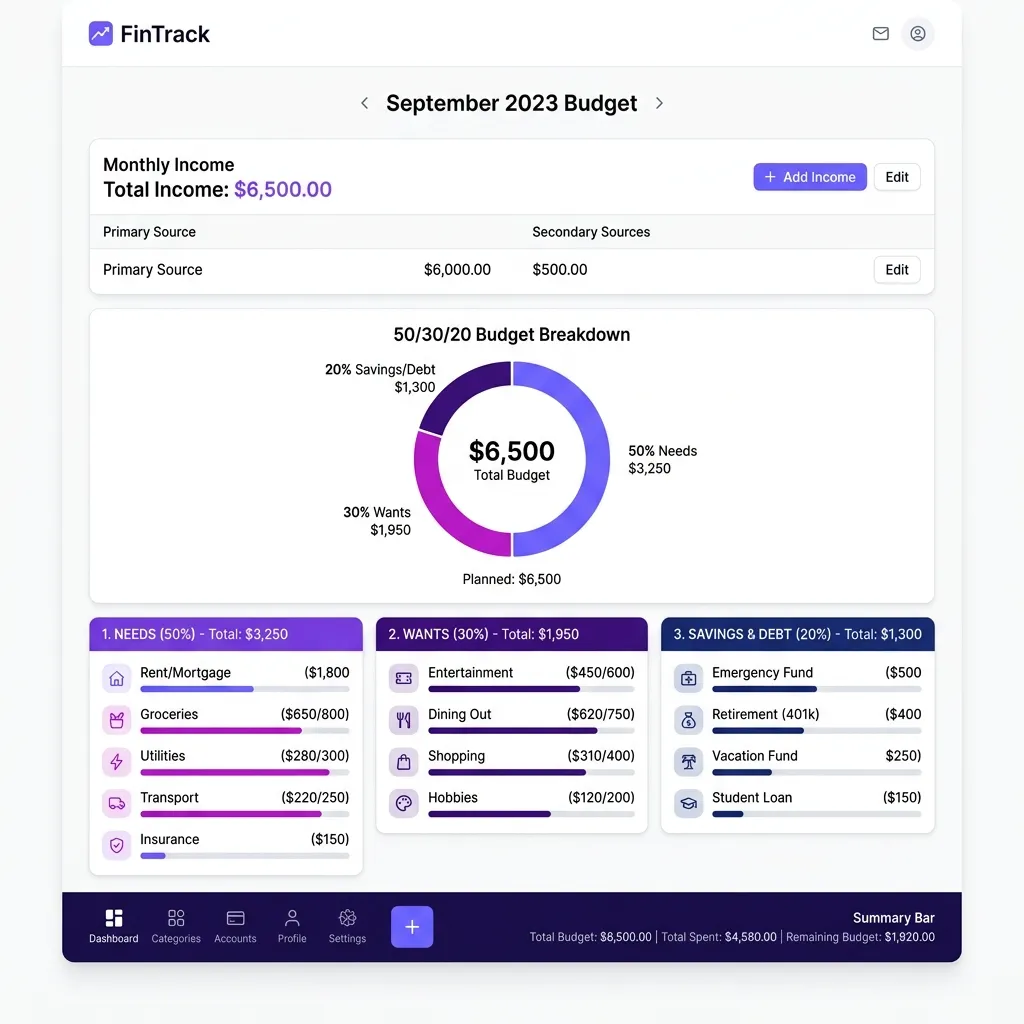
Popularized by personal finance experts, the 50/30/20 rule is a simple, percentage-based guideline for allocating your monthly take-home net income. It divides your money into three clear buckets:
1. 50% for "Needs" (Survival Essentials)
Half of your net income should cover your absolute necessities — things you cannot live without. If you lost your job tomorrow, these bills must still be paid to maintain basic survival and shelter:
- Rent, mortgage, or housing maintenance costs.
- Core utility bills (electricity, water, basic internet, and mobile phone plans).
- Groceries, basic food items, and essential medicines.
- Minimum credit card, student loan, or auto loan payments (legal obligations).
2. 30% for "Wants" (Lifestyle Choices)
This is your "guilt-free spending money." You are allowed to spend 30% of your earnings on things that enhance your lifestyle but are not survival essentials. In behavioral economics, keeping this bucket healthy prevents "frugality fatigue" and prevents budget burnout:
- Dining out, specialty coffee, and social drinks with friends.
- Entertainment subscriptions (Netflix, Spotify, gym memberships).
- Shopping for clothes, hobbies, and the latest gadgets.
- Travel, weekend trips, and vacation funds.
3. 20% for "Savings & Debt" (Future Wealth)
At least one-fifth of your money should be immediately set aside to build financial security and invest in your future. This is the engine of your long-term wealth:
- Building a 3-to-6 month Emergency Fund (kept in a separate high-yield savings account).
- Retirement investments (EPF, PPF, low-cost index funds, mutual funds, 401k).
- Aggressive principal repayments on high-interest debt (paying extra on top of your minimums).
Deep-Dive Technical & Scientific Budgeting Analysis
Zero-Based Budgeting (ZBB): Proactive Dollar Allocation
While the 50/30/20 rule provides an excellent top-down macro framework, detail-oriented planners often combine it with Zero-Based Budgeting (ZBB). Popularized by modern financial coaches, ZBB operates on a simple mathematical formula:
Under this system, every single dollar of your net monthly income is assigned a specific job before the month begins. If your monthly take-home pay is $4,000, you must map out where every single one of those $4,000 will go—whether it goes to rent, groceries, mutual funds, or movie tickets. If you finish your budget allocations and have $300 left unassigned, your job isn't done. You must proactively direct that $300 into a specific category, such as your emergency reserve or a future travel fund. This method eliminates the "leaky bucket" phenomenon, where unallocated money in checking accounts is mindlessly spent on impulsive retail purchases.
The Science of High-Yield Emergency Reserves
An emergency reserve is the ultimate psychological and financial shock absorber. Behavioral science shows that a lack of liquid savings is the primary driver of high-interest debt cycles. When an unexpected expense arises—such as a medical emergency or a car repair—individuals without liquid reserves are forced to rely on high-interest credit cards or personal loans, locking themselves into debt cycles.
The Battle Against Inflation: Historically, consumers parked their emergency funds in traditional brick-and-mortar savings accounts. However, these accounts often yield a negligible interest rate (e.g., 0.01% to 0.05% APY). When inflation hovers around 3% to 6%, money sitting in a traditional account actively loses purchasing power every day. To combat this, modern savers utilize High-Yield Savings Accounts (HYSAs) or highly liquid money-market mutual funds. These vehicles often yield interest rates that are 10x to 100x higher than traditional accounts while maintaining absolute, same-day liquidity.
Calculating the 3-to-6 Month Target: Your emergency fund should not be based on your gross income, but on your absolute essential expenses (the 50% "Needs" bucket). For instance, if your core survival expenses are $2,500 per month, your emergency fund target should be:
- 3-Month Baseline (Minimal Risk Profile): $7,500
- 6-Month Secure (High Risk / Freelancers): $15,000
Managing Highly Variable Freelancer Incomes
For freelancers, independent contractors, and small business owners, traditional budgeting rules can feel impossible because income fluctuates wildly. One month may bring $8,000 (a "hill" month), while the next might yield only $1,500 (a "valley" month).
To survive and thrive under variable cash flows, implement the "Hill and Valley Buffer System":
- Establish an Operating Buffer Account: Open a separate bank account specifically for business receipts. All client invoices and contract payments should be paid into this business account.
- Calculate Your Bare-Minimum Survival Number: Establish the absolute lowest amount of money you need each month to cover your personal "Needs" (housing, food, minimum debt). Let's say this is $2,000.
- Pay Yourself a Predictable Personal Salary: Each month, transfer a fixed "salary" (e.g., $2,500) from your business buffer account to your personal checking account.
- The Buffer Shock Absorber: During "hill" months when you make $8,000, do not increase your personal spending. Leave the surplus inside the business buffer account. When a "valley" month arrives and you only earn $1,500, use the accumulated surplus in your buffer account to pay yourself your full $2,500 salary. This mathematical approach smooths out your income and reduces financial anxiety.
Comparative Budgeting Methodologies
No single budgeting method works for everyone. Choosing the right style depends entirely on your personality, detail orientation, and financial goals. Use the comparative matrix below to identify your optimal system:
| Budgeting Method | Ideal For | Core Strength | Major Drawback | Recommended Tools |
|---|---|---|---|---|
| 50/30/20 Rule | Beginners & Hands-off managers | Simple macro tracking, low stress | Too broad for deep spending leaks | Spreadsheets / FairShare |
| Zero-Based (ZBB) | Detail-oriented planners | Absolute control over every dollar | Time-consuming, high maintenance | YNAB / Custom Sheets |
| Envelope System | Impulsive physical spenders | Tactile limits stop overspending | Inconvenient for online payments | Physical Cash Envelopes |
| Reverse Budgeting | Busy wealth accumulators | Guarantees savings targets first | Easy to overspend remaining cash | Automated Bank Sweeps |
Step-by-Step Practical Setup Checklist
Ready to build your budget? Follow this highly structured, step-by-step implementation guide to establish your framework in under an hour:
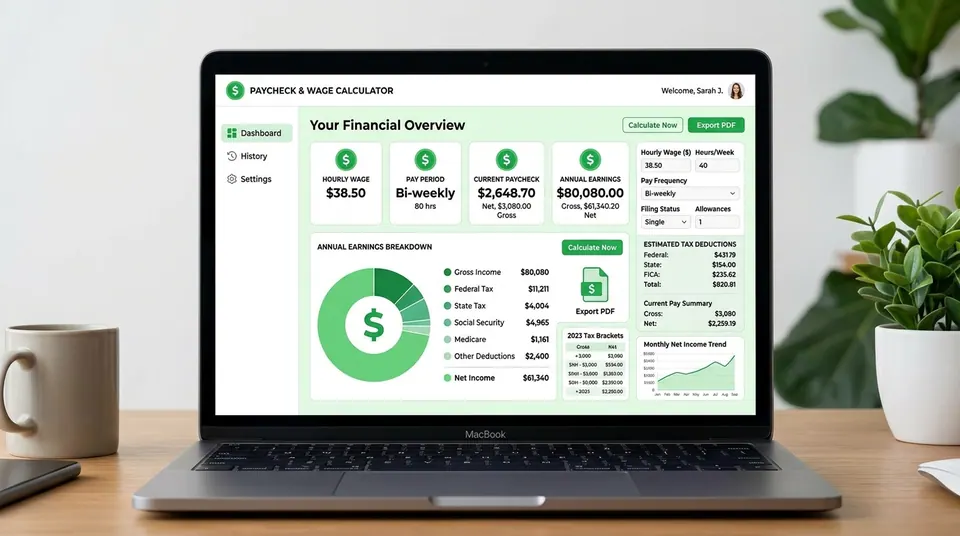
Calculate Net Monthly Income
Determine your absolute take-home pay. This is your salary after income tax, payroll taxes, social security, and health insurance premiums are deducted. If you are a freelancer, use your average lowest monthly income.
Audit the Last 90 Days of Expenses
Log into your online banking accounts and pull your statements for the last three months. Sort your expenses into categories to understand your realistic spending baselines and identify hidden leaks.
Cap Your "Needs" Category at 50%
Sum up your housing, utilities, groceries, transportation, and minimum debt payments. If this total exceeds 50% of your take-home pay, look for immediate cuts (e.g., renegotiate internet bills, switch to cheaper supermarkets, or downsize housing arrangements).
Automate Your "Savings & Debt" Sweeps (20%)
Set up automatic bank transfers to occur the morning after you receive your paycheck. Direct 20% of your net income straight into your separate High-Yield Emergency Reserve or investment broker account to ensure you "pay yourself first."
Track and Splurge Your "Wants" (30%)
Keep the remaining 30% in your checking account or transfer it to a designated card for daily lifestyle spending. This is your guilt-free spending money. Use it on entertainment, dining out, and travel with zero regret.
How to Handle Shared Expenses Cleanly
One of the biggest leaks in a monthly budget is untracked shared expenses. When you buy groceries for your roommates, split dinner with a partner, or pay for a group trip, keeping track of "who owes whom" in your head leads to mathematical errors and social awkwardness.
Implement these simple strategies to protect your relationships and your budget:
- Establish Splitting Rules Early: Before booking a group trip or signing a lease, agree on how expenses will be split (equal shares vs. proportional to consumption).
- Track Real-Time: Never wait until the end of a two-week trip to try and compile crumpled paper receipts. Log transactions the exact second they happen.
- Use Browser-First Tools: Avoid complex financial apps that require all your friends to create accounts and input personal details. Use simple, lightweight browser tools that let you input names, log expenses, and see exact settlements instantly.
Split Group Expenses Safely — Free
Use our browser-based FairShare Splitter to log group costs, split bills equally or proportionally, and calculate exactly who needs to pay whom. Works instantly in your browser with no signup required.
Open FairShare Splitter →Frequently Asked Questions (FAQ)
Q1: What should I do if my essential "Needs" exceed 50% of my income?
In high-cost-of-living urban areas, it is extremely common for housing and utilities alone to swallow 40-50% of income. If your Needs exceed the threshold, do not panic. Modify your allocation percentages temporarily to a 60/20/20 or 70/15/15 split. Treat this as a temporary phase. Actively work to reduce fixed costs by taking on a roommate, refinancing debt, or downsizing housing. Alternatively, focus on increasing your primary income stream or establishing side-hustles to bridge the gap.
Q2: Is minimum debt repayment considered a "Need" or a "Savings & Debt" allocation?
Minimum debt payments (such as the minimum monthly payment due on a credit card, auto loan, or student loan) are legally binding obligations. Failing to pay them will severely damage your credit score and incur legal fees. Therefore, minimum debt payments are categorized under "Needs." Any additional payments you make to aggressively pay down the principal balances of your debts faster fall under the 20% Savings & Debt allocation bucket.
Q3: How do I handle unexpected windfalls, bonuses, or tax refunds in my budget?
To make the most of lump-sum cash inflows without spending them impulsively, implement the financial "Rule of Thirds":
- One-Third to the Past: Pay down high-interest debt or boost your emergency fund to build safety nets.
- One-Third to the Future: Allocate to long-term retirement accounts or long-term financial goals.
- One-Third to the Present: Treat yourself! Spend this portion guilt-free on fun wants, travel, or shopping.
Q4: How often should I review or adjust my budget allocations?
You should do a brief monthly review (approx. 10 to 15 minutes) to ensure you stayed within your budget limits and to plan for the upcoming month's unique expenses (like annual car insurance premiums or holiday gifts). Additionally, perform a major budget audit whenever a significant life event occurs, such as receiving a raise, moving to a new apartment, getting married, or experiencing a career transition.
Q5: How do shared expenses with roommates or a partner fit into individual 50/30/20 allocations?
When splitting costs, your personal budget should only record your net share of the expense. For example, if the monthly rent is $1,600 and you split it 50/50 with a roommate, your budget should show a Need of $800, not $1,600. To prevent uncalculated group debts from distorting your actual cash flow, always log transactions immediately using a lightweight browser utility like FairShare, settling up balances regularly to keep your personal records highly accurate.